
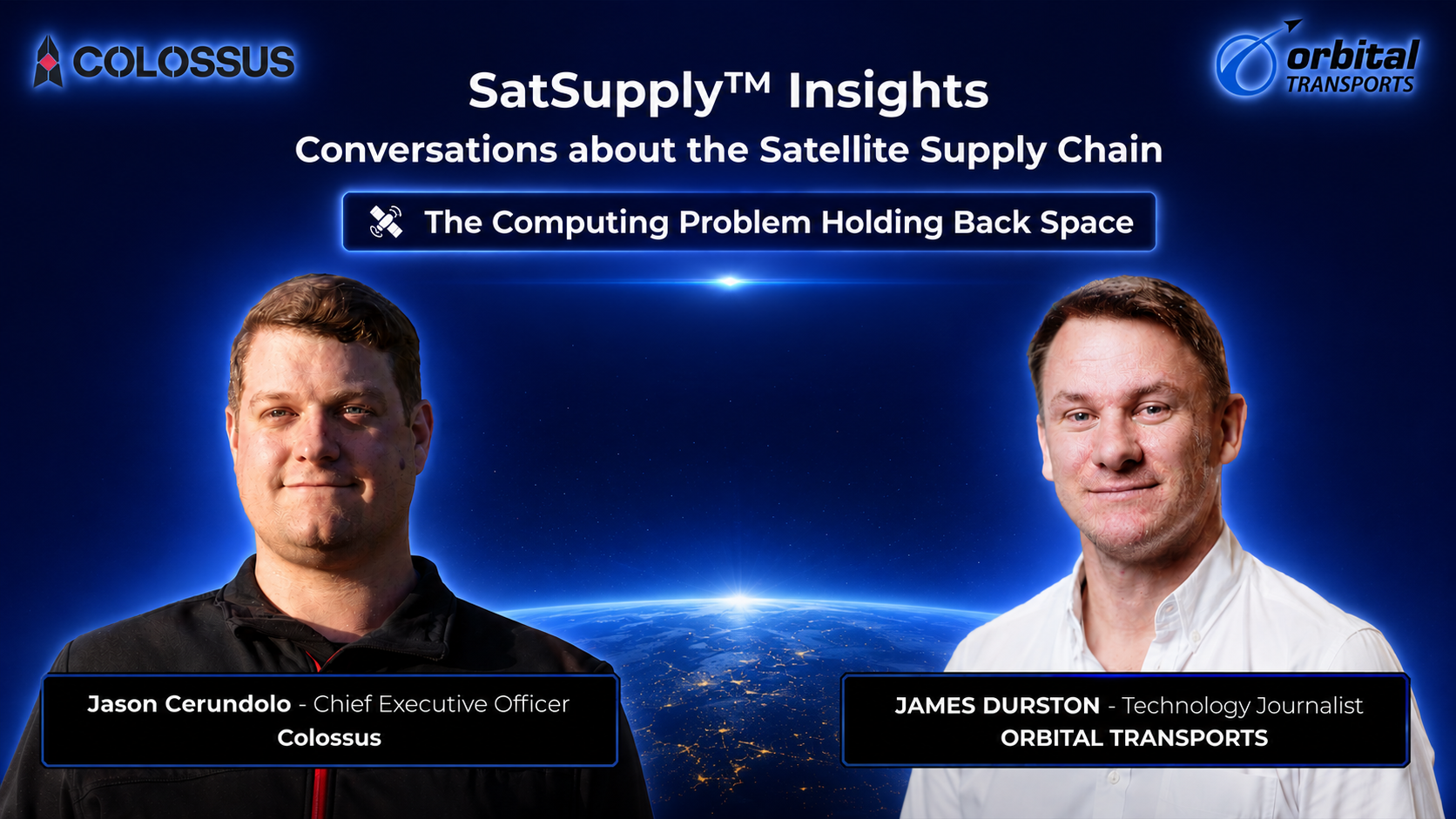
About this series of interviews
Behind every product and service on the SmallSat Catalog, there is world-leading expertise and domain knowledge. This interview series is all about helping you tap into that expertise and get the information you need to help with your own mission.
Colossus is building the computing infrastructure that modern spacecraft increasingly need. By combining commercial AI processors, space-qualified engineering, and system-level reliability, the company is enabling satellites to process data where it's generated instead of relying on decades-old space computing architectures.
Why was Colossus founded?
Colossus was founded around a simple observation: spacecraft were generating more data than ever before, but the computers available to process that data had not kept pace.
CEO and co-founder Jason Cerundolo likes to explain the problem using a communications analogy. In the 1990s, meeting a friend meant calling a landline, agreeing on a place and time, and hoping everything went according to plan. Today, smartphones let people exchange messages instantly, share locations, and adjust plans in real time. That same gap existed in space computing.
Many spacecraft still relied on computing hardware designed primarily for command and control tasks — turning systems on and off, managing power, and operating payloads. What was missing was the ability to perform serious onboard data processing.
Part of the inspiration came from watching NASA's Ingenuity helicopter fly on Mars. To make powered flight possible in the Martian atmosphere, engineers had to minimize weight while preserving capability. One of their solutions was to use a commercial smartphone-class processor for visual navigation. At the same time, many traditional space systems continued to rely on radiation-hardened processors whose architectures traced back decades.
The contrast was striking. If modern processors could help fly a helicopter on Mars, why weren't similar capabilities widely available throughout the space industry? That question became the foundation for Colossus. As Cerundolo describes it, the company's mission is to bring the last forty years of advances in computing and data-center infrastructure into the space environment.
What makes computing in space different from computing on Earth?
The two biggest differences are reliability and radiation.
On Earth, failed hardware can usually be replaced. If a solid-state drive fails in a data center, technicians can swap it out during routine maintenance. In space, that option generally doesn't exist. A failed component may need to continue operating for years without physical access, making reliability far more important than in terrestrial computing environments.
The second challenge is radiation. Even satellites operating in Low Earth Orbit encounter charged particles, cosmic rays, and other forms of radiation capable of disrupting electronics. These effects can range from temporary data corruption to permanent hardware damage.
Historically, the industry's solution was straightforward: use heavily shielded, radiation-hardened processors specifically designed to survive these environments. The downside is performance. Many traditional radiation-hardened processors deliver only a tiny fraction of the computing capability available from modern commercial hardware.
Colossus takes a different approach. Instead of relying entirely on older radiation-hardened processors, the company uses modern computing platforms and builds reliability into the system itself.
How does Colossus make modern processors reliable in space?
According to Cerundolo, reliability is not a single technology. It is a system-level design philosophy that spans hardware, software, and operations.
The process begins with component selection. Colossus carefully evaluates commercial processors and electronic components to identify devices that perform well in radiation environments. The company then performs extensive radiation testing using proton and heavy-ion beams to characterize how those components behave under real-world conditions.
Hardware protection mechanisms are added to mitigate failures when they occur. Examples include:
- Current-limiting electronic fuses
- Latch-up protection circuitry
- Automated fault detection systems
- Recovery and reset mechanisms
Software resilience is equally important. Multiple copies of bootloaders and operating systems help ensure recovery after faults. Error-correction systems detect and repair corrupted data, while backup images allow systems to restore functionality if problems occur.
At the system level, multiple computing nodes can work together similarly to servers in a terrestrial data center. When everything is functioning normally, performance scales across multiple processors. If one unit experiences a problem, workloads can be reassigned while that system recovers.
The goal is not to eliminate every possible failure. The goal is to continue operating despite failures. As Cerundolo points out, even major internet platforms achieve high availability not because their computers never fail, but because their systems are designed to work around failures when they occur.
What are customers actually buying?
Customers are not simply purchasing a processor board. They are purchasing a complete onboard computing solution.
Without a ready-made platform, organizations often need to:
- Select processors and components
- Design custom circuit boards
- Develop software drivers
- Modify operating systems
- Create mechanical packaging
- Validate hardware and software performance
That process can require years of development effort. Colossus shortens that timeline significantly by providing integrated systems that are ready for spacecraft deployment.
For developers, the experience is intentionally familiar. Connect power and Ethernet, open a terminal, and the system behaves much like a Linux workstation. Rather than building computing infrastructure from scratch, customers can focus on the applications that differentiate their missions.
As Cerundolo describes it, the value proposition is straightforward: get operational in weeks or months instead of years.
Falcon: Colossus' next-generation space computer
While Kestrel established Colossus' presence in the market, Falcon represents the company's latest generation of onboard computing hardware.
Falcon is built around NVIDIA's AGX Orin platform and is designed to deliver high-performance AI and data processing capabilities in a spacecraft-ready package.
The system combines:
- NVIDIA AGX Orin processing
- Custom carrier electronics
- Radiation mitigation circuitry
- High-speed interfaces
- Integrated storage
- Spacecraft-ready mechanical packaging
The objective is to transform a commercial computing module into a complete onboard processor that customers can integrate directly into their spacecraft.
One of Falcon's defining features is its modular architecture. Through PCIe-based expansion boards, customers can add new capabilities without redesigning the core platform.
Available expansion options include:
- Additional Ethernet interfaces
- FPGA-based processing
- SpaceWire connectivity
- Camera Link support
- Generic LVDS interfaces
- High-speed PCIe expansion
- Specialized imaging interfaces
The approach is similar to expanding a desktop workstation with new hardware, except adapted for the requirements of spaceflight. Rather than building a new computer for every mission, customers can tailor Falcon to specific payloads and applications through modular upgrades.
Why did Colossus build an Ethernet switch for spacecraft?
As spacecraft become more sophisticated, networking has become an increasingly important challenge. Modern payloads often include cameras, processors, flight computers, sensors, and communications systems that all need to exchange large amounts of data.
Many of these systems are moving toward Ethernet-based architectures. Recognizing that trend, Colossus developed Razorback, a spacecraft-ready Ethernet switch designed specifically for onboard networks.
Cerundolo compares the concept to a conventional Ethernet switch used in a home or office environment. Just as a terrestrial switch connects computers, printers, and other devices, Razorback connects the growing number of Ethernet-enabled systems onboard modern spacecraft.
The platform includes capabilities beyond simple switching. Features include Layer 3 managed networking, VLAN segmentation, Time-Sensitive Networking (TSN), and advanced network management functions.
These capabilities allow spacecraft developers to build more sophisticated and deterministic onboard networks while maintaining compatibility with modern Ethernet-based hardware.
Who are Colossus' customers?
Colossus primarily serves two groups: spacecraft integrators and payload developers.
Some customers purchase Colossus hardware and integrate it with cameras and sensors sourced from other vendors. Others use the platforms to support autonomous operations or advanced onboard analytics.
Several application areas appear repeatedly.
Space Situational Awareness — Tracking and monitoring other spacecraft generates large volumes of sensor data that must be processed in real time.
Rendezvous and Proximity Operations — Docking and close-range spacecraft maneuvers require continuous situational awareness and rapid decision-making.
Earth Observation — Modern Earth-observation payloads can generate massive amounts of imagery and sensor data that benefit from onboard filtering and analysis.
In each case, the challenge is similar: more data is being generated than can practically be transmitted to Earth.
Falcon versus Kestrel
Falcon represents a significant leap beyond the earlier Kestrel platform.
According to Cerundolo, Falcon delivers approximately 200 times the AI processing performance of Kestrel. The tradeoff is increased power consumption and physical size. However, the increase is not proportional — Falcon consumes roughly four times the electrical power while delivering hundreds of times the AI capability.
The shift mirrors broader trends across the satellite industry. Today, many commercial spacecraft fall into larger small satellite classes ranging from roughly 50 to 200 kilograms and beyond. Although larger spacecraft provide more power and thermal capacity, they leverage more powerful sensors and generate more payload data at higher rates.
As payload capabilities increase, onboard computing requirements grow alongside them. While Kestrel was designed around smaller CubeSat-class missions, Falcon was developed to address those evolving needs of more powerful sensors and larger small satellite classes.
How is AI being used in space today?
When people hear the term AI, they often think about large language models. Most space applications today are very different.
The majority of onboard AI workloads involve image processing, computer vision, and data reduction. Modern imaging systems can generate tens of gigabits of data every second. The challenge is determining what information is valuable and what information can be discarded.
As Cerundolo explains, a common principle in image processing is simple: throw away as many unnecessary pixels as possible, as quickly as possible.
One example is maritime monitoring. A satellite imaging the Pacific Ocean may collect enormous volumes of imagery, most of which contains little actionable information. Instead of transmitting every image to the ground, onboard AI can inspect each frame in real time, identify ships, extract key information, and compare detections against AIS (Automatic Identification System) broadcasts. If a vessel is not transmitting its location as expected, operators can flag it for additional investigation. The satellite then transmits only the relevant findings rather than every raw image.
The result can be extraordinary reductions in bandwidth requirements. According to Cerundolo, some applications can achieve data reductions of 1,000-to-1 or even 10,000-to-1.
Other applications include:
- Pose estimation for spacecraft navigation
- Rendezvous and docking operations
- Object classification
- Earth-observation analytics
- Sensor data filtering
- Autonomous decision support
The common theme is moving intelligence closer to where the data is generated.
What does deployment look like?
The most successful customers typically already run GPU-based applications on Earth. They know what software they want to execute. What they need is a reliable way to run those workloads in space.
Cerundolo recommends starting with Colossus' publicly available documentation. Unlike many aerospace suppliers, the company makes key engineering documents available without requiring a nondisclosure agreement. This allows technical teams to evaluate compatibility early in the process.
From there, discussions focus on:
- Mission objectives
- Performance requirements
- Integration timelines
- Hardware selection
- Potential customization needs
In many cases, existing products can be deployed with minimal modifications. The goal is to make the transition from terrestrial AI development to orbital deployment as straightforward as possible.
Where onboard computing is heading
Spacecraft are becoming increasingly autonomous. Sensors continue to generate larger volumes of data. Constellations are growing. Real-time decision-making is becoming more important.
The limiting factor is no longer whether AI and advanced computing can operate in space. The challenge is providing enough performance while maintaining reliability in harsh environments.
Colossus is betting that the future of space systems will look increasingly like distributed computing systems on Earth. Rather than treating spacecraft as remote sensors that simply collect data, future missions will process, analyze, and act on information directly in orbit.
That shift has implications across Earth observation, space situational awareness, autonomous navigation, rendezvous operations, and beyond. The trend is clear: more intelligence is moving onboard. The infrastructure required to support that intelligence is exactly where Colossus is focused.
About Colossus
Colossus develops high-performance computing and networking infrastructure for spacecraft. Its products combine modern commercial processors with system-level reliability techniques designed for radiation environments and long-duration missions. The company's portfolio includes Falcon, Kestrel, and Razorback, supporting applications ranging from AI and Earth observation to autonomous spacecraft operations.
Watch the full interview
Hear Jason Cerundolo discuss radiation resilience, onboard AI, spacecraft networking, Falcon, Kestrel, and the future of high-performance computing in orbit.
Get Colossus for your mission
Procure Falcon, Razorback, and other Colossus products through the SmallSat Catalog.
Whether you're building an Earth-observation constellation, an autonomous spacecraft, or a next-generation AI payload, Colossus provides the computing infrastructure needed to process data where it matters most: onboard the spacecraft.