
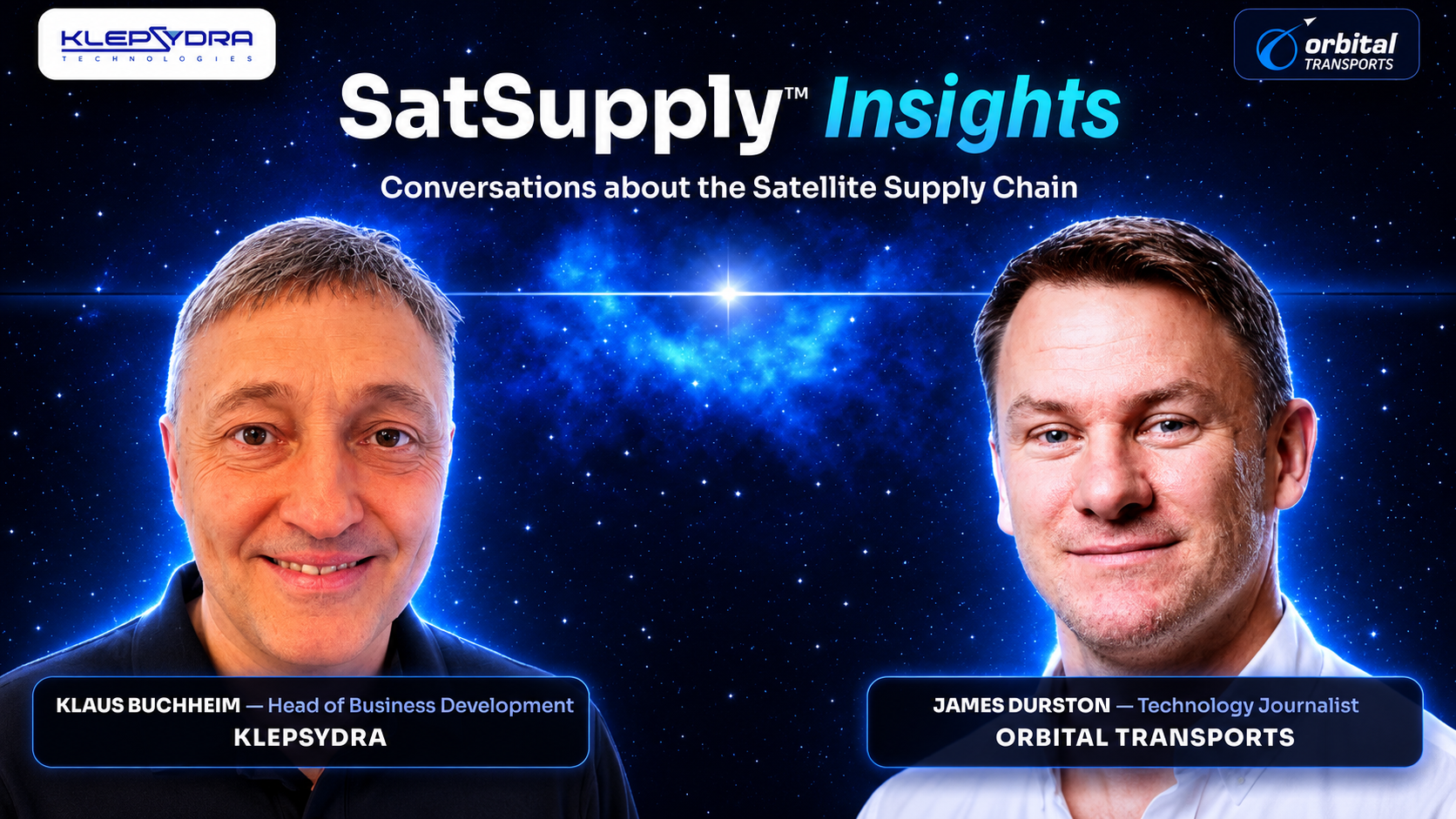
What is Klepsydra and what problem does it solve?
Klepsydra is a Swiss software SME, founded about six and a half years ago, that accelerates AI inference on satellites. The core problem it solves is a mismatch: spacecraft have tiny compute budgets but generate enormous volumes of data. Most space companies trace their origin to a mission. Klepsydra traces its to a trading floor.
Klaus Buchheim, who leads business development at Klepsydra and spent more than 18 years in the European space industry, explains that the founder came out of Swiss banking, high-speed financial trading, "where speed and milliseconds indeed mean a lot of money." While doing a PhD in aerospace in parallel, the founder kept reaching for a technique from his trading days: lock-free programming, a way of letting many processes work on shared data without stopping to wait on locks, which is how you squeeze latency out of a system.
The insight was that space had the same problem in a different costume. As Buchheim recalls the founder realizing, the space industry runs on resource-constrained systems yet needs to process huge amounts of data. That mismatch became the company.
What does onboard AI actually do on a satellite?
The simplest way to understand onboard satellite AI is the difference between sending pictures and sending answers. Without onboard processing, an Earth-observation satellite downlinks every frame, including endless images of empty ocean. With it, the satellite runs detection in orbit and sends only what matters.
| Without onboard AI | With Klepsydra onboard AI | |
|---|---|---|
| What gets downlinked | Every raw frame, mostly empty scenes | Only the detections that matter |
| Bandwidth used | High | Low |
| Ground-processing cost | High | Low |
| Time to a usable answer | Slow (process on the ground) | Fast (decision made in orbit) |
As Buchheim puts it: "Ship here, take a look. And then you just send that information instead of all the images of vast empty ocean."
Because Klepsydra sells an acceleration layer rather than a finished application, it stays largely use-case agnostic. The patterns Buchheim sees repeatedly:
- Early alerting: extract an event onboard (a detected ship, a wildfire) and downlink the alert, not the raw scene.
- Data reduction: discard low-value imagery before it leaves the satellite. In optical remote sensing that often means dropping cloud-covered frames; the same logic now extends to synthetic aperture radar (SAR), which images through cloud and darkness.
- Rapid anti-jamming in telecom: an onboard model detects a jamming attempt and triggers frequency hopping fast enough to stay ahead of the interference.
- Autonomous maneuvers: docking and rendezvous, with applications reaching toward re-entry and launch vehicles.
- Predictive maintenance: the satellite flags a developing fault itself, so ground teams aren't manually combing telemetry.
- Constellation autonomy: splitting intelligence between AI onboard each satellite and AI on the ground across a large fleet.
"It's an extremely broad field," Buchheim says, "and every day people invent something new."
Why did onboard satellite AI become a real product?
Six and a half years ago, AI on a satellite was a science project. Buchheim's analogy is blunt: it was the topic "the intern did in the corner of the lab", glued together quick and dirty to prove the concept. And it worked. The proof-of-concept era established that onboard AI was useful.
The hard part was everything after. Moving from one demo to a deployed fleet changes the questions entirely. A throwaway prototype can run on a cheap processor during a short in-orbit demo, and nobody minds if it dies in six weeks. A production system has to run for seven years on a radiation-hardened processor—a chip built to survive space, and far less powerful than the commercial parts an engineer prototypes on. Now the questions get sharp: Does the software need formal certification? Can you still ship the open-source stack you grabbed off the internet? How do you avoid rebuilding the whole application, and burning another multi-year cycle, every time the mission changes?
That gap between "it works once" and "it works at scale, for years, without a rebuild" is the gap Klepsydra sits in.
What do customers actually get - software or hardware?
Klepsydra ships software only. The customer receives an inference-engine library they integrate into their own stack, and it runs across a wide range of hardware. Buchheim describes two paths: a customer who wants full flexibility gets builds for many different processors, while a customer who already knows their target, say, a specific ARM core, gets a dedicated build for it. Either way, no boxes change hands.
Klepsydra AI – Space Edition is listed on the SmallSat Catalog for direct procurement.
How does space software differ from ground software?
Less than you'd think, with one real exception: certification. Klepsydra is currently undergoing ESA software certification. Once a software element is certified, changing it triggers recertification, so updates become more deliberate than on the ground, where you can iterate freely. "On the space side you maybe think a bit more," Buchheim says. Beyond that, he argues, the core engineering is the same.
The interesting move is that Klepsydra runs the logic in reverse. Space-grade certification is a credential most software never earns, so the company takes that reliability into non-space markets, industrial automation, for instance, where a system also can't afford to lose control of an AI inference engine. The pitch there is simple: this is certified to space standards.
How much AI expertise do you need to use Klepsydra?
The customer brings the AI; Klepsydra makes it fast. The company doesn't supply models or training. It provides the engine that runs the model fast on the space processor. That division is deliberate, because training a good model and writing high-performance inference code are genuinely different disciplines. By owning the performance layer, Klepsydra lets a customer's AI engineer focus on building and training the model without worrying about how it will perform once it's squeezed onto a constrained space processor.
A deployment in practice: sharpening weak signals for ship detection
One customer needed to pull very weak signals out of noise, improving the signal-to-noise ratio with an AI algorithm, in an application tied to AIS (Automatic Identification System), the transponder data ships broadcast to identify themselves. They were running the workload on an older NVIDIA GPU that was already maxed out, and they wanted more performance.
Klepsydra's GPU version wasn't fully ready at the time, so the team adapted its framework to that specific GPU, took the customer's model unchanged, implemented and tested everything on the ground, and uploaded the complete software stack to the satellite's onboard computer to run in orbit. The result, as Buchheim understood it, was a meaningful signal improvement that let the customer detect ships faster and more reliably. He's candid about a recurring reality of selling an acceleration layer: a lot of the time, the team barely knows the full end application.
How fast can a deployment move?
Faster than the space timelines you'd expect, because most of the work isn't space-specific. Buchheim offers a non-space example from two weeks earlier: a partner building a driver-assistance algorithm for a self-driving car to run a joint demo. "He started on Monday morning, Friday evening everything was running, and he had the 20% improvement." In principle, space can look similar; the part that adds time is the uplink to the spacecraft, not the integration itself.
What's next: neuromorphic chips and transformer models
Beyond general housekeeping, Buchheim names two priorities on the roadmap.
The first is neuromorphic processors, brain-inspired chips that deliver very low power consumption for certain workloads. On March 12, 2026, Klepsydra announced a strategic partnership with BrainChip to build a heterogeneous runtime for the BrainChip Akida processor family. The runtime lets developers offload compute-heavy AI layers to the Akida neuromorphic accelerator while staying synchronized with host processors like ARM, RISC-V, and x86, pitched at processing up to 10x more data with 50% less power.
The second is transformer-based models, the architecture underneath modern LLMs and a growing share of edge AI. Klepsydra doesn't accelerate transformer layers yet, and that's the year's other build: extending the same acceleration it gives conventional models to transformers. Buchheim hopes for an alpha by the end of the year, with the honest caveat that ESA project work sometimes takes priority over the product roadmap.
Where onboard satellite AI is heading
Satellites are turning from sensors into machines that decide. As constellations grow and missions demand more autonomy—onboard alerting, anti-jamming, predictive maintenance, distributed intelligence across a fleet—the constraint stops being "can we run AI in space" and becomes "can we run it fast enough, reliably enough, on hardware that survives for years." That is precisely the seam Klepsydra works. With ESA certification underway and bets placed on both neuromorphic and transformer architectures, the company is positioning its inference layer for the next generation of spacecraft rather than the last. As Buchheim frames it, onboard AI has graduated from the intern's corner of the lab, and the engineering question now is how to make it production-grade at scale.
About Klepsydra
Klepsydra is a Swiss software SME focused on onboard data processing and onboard AI for satellites and space systems. Its software-only inference engine accelerates customers' AI models on resource-constrained, radiation-hardened space hardware, drawing on low-latency, lock-free programming techniques. The company is completing ESA software certification and develops support for emerging architectures including neuromorphic processors and transformer-based models.
Watch the Full Interview
Hear Klaus Buchheim discuss Klepsydra's framework, deployment stories, and the road to neuromorphic and transformer-based AI in orbit.
▶ Watch the full interview on YouTube
Or open it directly: https://youtu.be/ns4sc676tB8
Get Klepsydra for your mission
Procure Klepsydra AI – Space Edition directly through the SmallSat Catalog — the same software-only inference engine described in this interview, ready to integrate with your onboard processor of choice.
View Klepsydra AI – Space Edition →
Need complementary hardware, payloads, or integration services? Browse the full SmallSat Catalog — a curated portal of products and services for end-to-end smallsat mission development.