
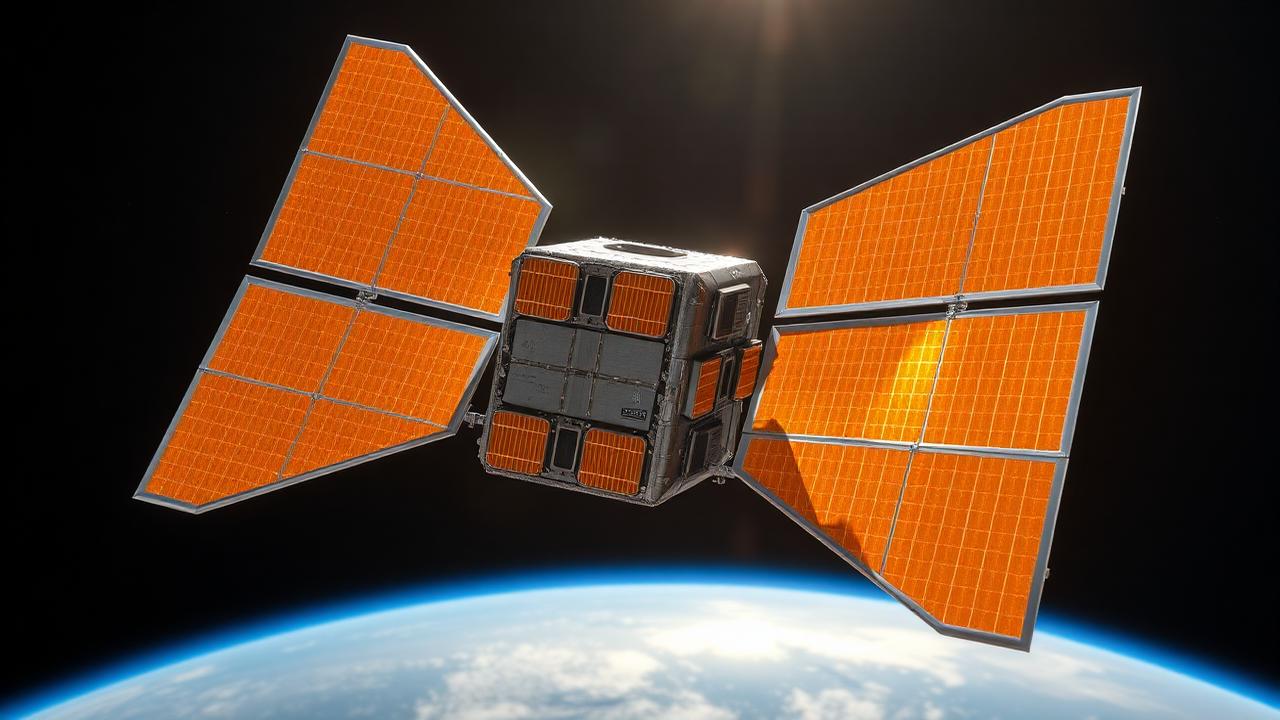
Innovations in CubeSat Solar Array Technology
The field of CubeSat solar arrays is experiencing rapid advancement, with new designs pushing the boundaries of power generation in compact form factors. Recent innovations are enabling small satellites to tackle increasingly power-intensive missions.
One of the most exciting developments in CubeSat solar array technology is the emergence of origami-inspired deployable solar arrays. These ingenious designs offer several advantages:
- Compact Stowage: Folding patterns allow large array areas to fit within a 1U (10x10x10 cm) volume during launch.
- High Power Output: Despite their small stowed size, these arrays can generate 100W or more when deployed.
- Lightweight: Advanced materials keep the mass low, typically around 1–1.5 kg for a 100W class array.
Power Generation Capabilities
When selecting a solar array for a CubeSat, one of the primary considerations is the power generation capability. Solar arrays should be designed to maximize power output within the constraints of the CubeSat's size and mass. Efficiency in converting solar energy into electrical power is crucial, especially for missions requiring high power density. Factors to consider include the type of solar cells used (e.g., triple-junction gallium arsenide cells for higher efficiency), the array's surface area, and the angle of incidence of sunlight. Additionally, the array's ability to track the sun or adjust its orientation can significantly enhance power generation, although this adds complexity to the system.
Deployment Mechanism
The deployment mechanism of a CubeSat solar array is a critical design aspect that addresses the challenge of safe stowage during launch while ensuring reliable deployment in orbit. Key considerations include reliability and compactness, as the mechanism must deploy the array without damaging or interfering with other satellite components, while fitting within tight volume constraints. Deployment methods range from passive systems using stored energy (e.g. springs) to active motorized mechanisms and innovative shape memory alloy (SMA) solutions.
Engineers must carefully consider deployment speed, force requirements, and locking mechanisms to ensure successful operation in space. Resettable mechanisms allow for multiple deployments, facilitating pre-launch testing. Material selection for hinges and components is critical for durability in the harsh space environment. By balancing these factors, CubeSat designers can create solar array deployment mechanisms that are both compact and reliable, optimizing specific power and power density for these small satellites.
Size and Form Factor Considerations
The size and form factor of the solar array must align with the CubeSat's overall design. While larger arrays can generate more power, they also increase the satellite's mass and power, potentially affecting launch costs and mission feasibility.
A balance must be struck between power needs and the physical constraints of the CubeSat. For instance, a 1U CubeSat might opt for body-mounted solar cells or a small deployable array, while larger CubeSats can accommodate more extensive arrays.
It is important to note that while larger arrays can generate more power, they also introduce challenges in terms of deployment mechanisms, thermal management, and attitude control. Therefore, the solar array design must be carefully integrated with other subsystems to ensure overall mission success.
Research Papers
Origami solar panel overview for cubesats:
Buscicchio, A., Alessandrino, G., Troise, A., Sironi, T., & Gloder, A. (2023, October). SolarCube: An Origami-Inspired Lightweight Deployable Solar Panel for Nanosatellites. In 2023 13th European Space Power Conference (ESPC) (pp. 1-9). IEEE.
Innovative solar panel design for cubesat:
Santoni, F., Piergentili, F., Donati, S., Perelli, M., Negri, A., & Marino, M. (2014). An innovative deployable solar panel system for Cubesats. Acta Astronautica, 95, 210–217.
High power extendable panel for cubesats from NASA:
Senatore, P., Klesh, A., Zurbuchen, T. H., McKague, D., & Cutler, J. (2010, May). Concept, design, and prototyping of XSAS: A high power extendable solar array for CubeSat applications. In Proceedings of the 40th Aerospace Mechanisms Symposium.